Lojong Cards and Booklet

Lojong Cards and Booklet
This self-published deck and booklet are the intellectual property of Beverly King. Please do not copy or reproduce any photos or blog posts without permission.

Monday, December 19, 2016

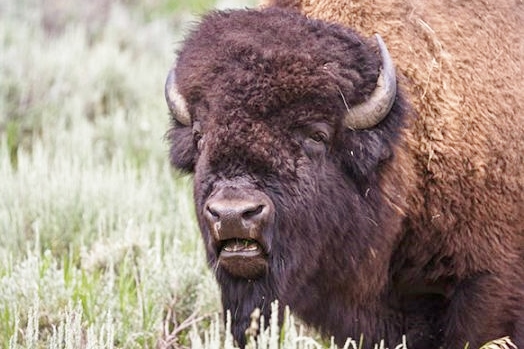
Always meditate on whatever provokes resentment.

Bison photo from yellowstonepark.com

          Bison are just one form of 150 different ruminant species, including cows, goats, deer, giraffes, moose, and elk. A ruminant has a four-compartment stomach; this digestive system allows the animal to obtain nutrients from plants by fermenting what is eaten. These mammals are often observed 'chewing their cud' - partly digested food that is returned to the mouth for further chewing. Resentment is a similar form of rumination, except we get nothing beneficial from it. It might actually be considered closer to acid reflux, because we relive a perceived injustice over and over again along with the same burning emotion. The forty-ninth slogan asks us consider not the resentment itself, but what provokes it. We are caught only in a memory, not an event that is currently happening. Have we been provoked because of an opinion or expectation that we cling to? Has our security been threatened, do we fear a loss of some kind? Even if the injustice is valid, resentment keeps our vision narrow and shuts us off from joy. We remain in the emotional role of a victim instead of becoming a rational proponent of change. 'Chewing the cud' of resentment may make us feel like we're doing something constructive, but it actually keeps us stuck in a never-ending cycle.


The bitterness that arises from a long-held wrong, gone over and over, encases the heart, making it difficult for love to get through. ~ Sharon Salzberg

For more information on the forty-ninth slogan, go here.

Monday, December 12, 2016

Train without bias in all areas.

Monarch caterpillar photo by Twan Leenders

          Though monarch butterflies may sip nectar from a variety of flowers, they nearly always lay their eggs on milkweeds. Their preference is intended to give the caterpillars that will feed on them a tool for survival. The milkweed's sap contains a chemical that will become a part of the caterpillar's body when it consumes the leaves, causing the larvae to taste terrible. Predators like birds have learned to recognize the caterpillar's black and yellow stripes and steer clear of them when looking for food. The taste is even transferred to the butterfly after the caterpillar goes through its metamorphosis. When we practice lojong, it is tempting to have our own preferences too. We may convince ourselves that certain situations or people don't apply to the slogans. If we are having a bad day, we may rationalize taking a break from practice for a while. Yet slogan forty-eight encourages us to train wholeheartedly and without bias, no matter what conditions arise. The fodder for training that we are sure will be so bitter may be what provides the most benefit.

The lojong spirit comes from integrating equanimity and loving-kindness, so that we ground our compassion in impartiality. ~ Traleg Kyabgon

For more information on the forty-eighth slogan, go here.

Monday, December 5, 2016

Make the three gates inseparable.

Okra flower and pod photo by Bob Richmond

          Imagine a gardener going to the farming supply store and buying seeds indiscriminately; he doesn’t even bother to look at the packs to see what vegetables he’s chosen. After planting the seeds and watering them for many weeks, the plants begin to produce flowers and then vegetables. But the gardener becomes upset and frustrated when he sees what has grown: “I didn’t want okra, peppers and peas! I wanted tomatoes, cucumbers and squash!” His friends question him as to why he didn’t look at the seed packets before planting the seeds. Mind training allows us to be aware of the seeds of emotions and thoughts before we plant them. The mind’s yield of words and actions are based on the seeds we’ve sown and watered there. The three gates are the virtues of the mind, speech and body, and we would be wise to be aware of what we allow to pass through them. What passes through those gates will likely wind up growing in our yard, whether we want it to or not.


Every act, word, and thought in our daily life has the power to bring forth a fruit. 
~ Thich Nhat Hanh

For more information on the forty-seventh slogan, go here.

Monday, November 28, 2016

Don’t allow three things to diminish.

Photo by Sindre Kinnerød (worldwildlife.org)

          Ursus maritimus (‘sea bear’) evolved from terrestrial brown bears (Ursus arctos). Though the fur of the polar bear appears white, it is actually transparent; their black skin allows them to soak up as much of the sun’s rays as possible. These bears are dependent on sea ice for hunting, mating and denning. While their evolution allowed them to thrive as a part of the Arctic ecosystem, rising temperatures from climate change has now created a life of struggle. As more of the pack ice diminishes, it has become increasingly difficult for polar bears to travel, feed and raise young. Whether they survive or become extinct is intricately tied to whether the ice endures. Slogan forty-six cautions that the durability of our practice relies on respect for our mentor, enthusiasm for the teachings and a firm commitment to awaken our mind and heart. If we are interested in more than just a fling with mind training, we will make sure these things don’t diminish. Unlike the polar bear, we do have a choice.

Go forward with curiosity, wondering where this experiment will lead. This kind of open-ended inquisitiveness captures the spirit of enthusiasm, or heroic perseverance. ~ Pema Chodron

For more information on the forty-sixth slogan go here.

Monday, November 21, 2016

Take on the three principal causes.

Beaver photo by Joanne Kennedy

          Beavers rely on three resources to build their dams: a slow-moving stream with a mud bottom, hardwood trees, and stones. Trees with small trunks are cut and placed in the water with the butt downstream. The butts of these logs are weighed down with heavy rocks; the weight of the stones and the stream’s current force the ends down into the mud bed. Branches form the superstructure around the logs, layered to construct walls from 2 to 3 feet thick. Openings between the branches are stuffed with mud and vegetation to further seal the structure. Access to the lodge is through an underwater tunnel, which helps protect the beaver from predators. The ‘three causes’ in this slogan are the primary resources needed for a sturdy foundation; these three things are what will support us as we travel our spiritual path. The first is a compassionate mentor who can teach effectively, and whose knowledge and experience make him or her qualified. The second is our devotion to the teachings themselves – we enthusiastically apply ourselves to the principles and practices. The third is the support we find to continue our training – the encouragement of friends and an economic resource. Just as the beaver is constantly repairing its dam, so we must not become complacent in maintaining the strong base that will help us move forward.

To practice this slogan is simply to recall all of this when your get grumpy or dissatisfied: remember your community and teachers, remember the importance of mind training, remember that you have what you need to do it. ~ Norman Fischer

For more information on the forty-fifth slogan, go here.

Monday, November 14, 2016

Train in the three difficulties.

Photo by Mark Lentz

            Striped skunks are generally passive animals, yet they are well-known for their defensive behavior. If these skunks feel threatened, they will raise their tail and stomp their front legs as a warning. Intruders or predators who fail to back off get sprayed with a repulsive-smelling musk that can travel up to 6 meters. The oily spray is difficult to remove and can cause nausea. If sprayed in the eyes, it may cause intense pain and temporary blindness. Most animals only need one such encounter to learn to keep their distance. Fortunately, a skunk’s black and white coloring makes them easy to recognize. Likewise, the three difficulties encourage us to recognize, back off and refuse to engage our kleshas – strong emotions that arise in us and lead to suffering. We don’t need to fight them; we just pull back and don’t react as we normally do. Instead of getting hooked by thoughts which add fuel to our desire, we relax and let the emotional energy move through us. As the emotion dissipates, we experience a sense of freedom rather than misery. Once these intense states begin to lose their seductive appeal, we will make it a practice to avoid them.

Practice paying attention to the tiny little shifts of thought that, like a match to a fuse, cause a big explosion of confusion. ~ Judy Lief

For more information on the forty-fourth slogan, go here.


Monday, November 7, 2016

Observe these two, no matter what.

Dormice photo by Miroslav Hlavko

          Ethologists use naturalistic observation to study animals. Focusing on behavior patterns, they are interested in the responses that are triggered by the conditions in the animal’s environment. These scientists compile an ethogram, or activity catalog, of a species throughout its life cycle. For each behavior pattern noted, ethologists ask, “How does this impact the animal’s chance of survival and ability to reproduce?” Though staying alive and procreation may be the primary focus of wild animals, the two vows of slogan forty-three asks us to redirect our concerns to encompass more than just self-preservation. The vow of refuge shapes the choices we make through following the example and teachings of Buddha while drawing on the support of our spiritual community. The vow of the bodhisattva shapes our relationships through our commitment to be of beneficial service to others. These two promises give us a reason to stay grounded in reality rather than trying to escape it, which is what waking up is all about.

All vows are included in this one commitment: to be committed to paying attention to our lives, to be honest about what is going on and unflinchingly realistic about how we are behaving and thinking. ~ Norman Fischer

For more information on slogan forty-three, go here.